Live
Choose the assistant for the work
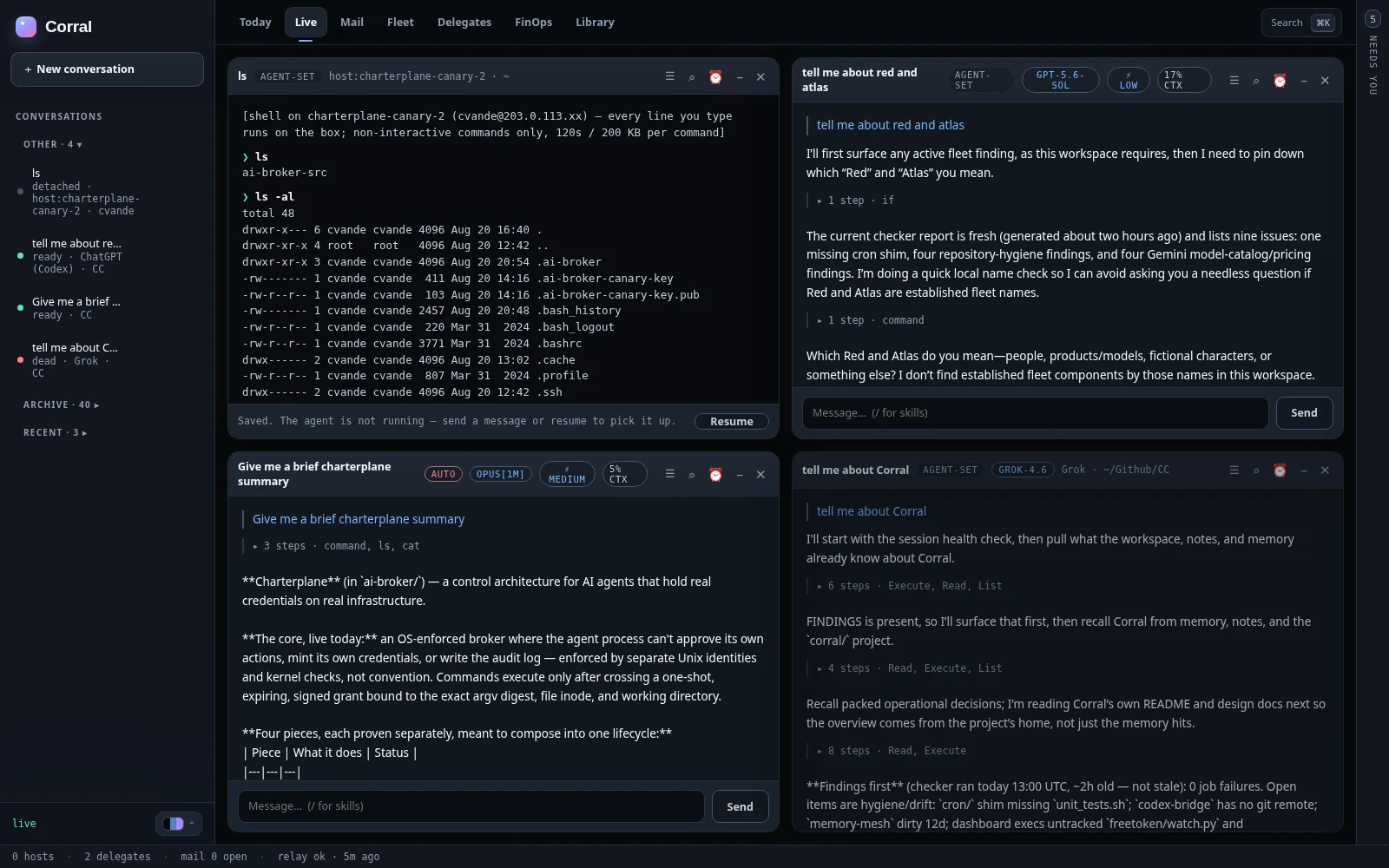
Claude Code, Codex, Grok, Gemini through Antigravity, and local Ollama models run side by side. Fireworks and direct DeepSeek add paid model options for work within their data limits. Cloud workers and SSH shells have their own panes; the picker shows which lanes are available.
Needs you
Every approval, one rail
Permission requests arrive in one rail with the command or tool arguments and, where available, the file diff. The decision is bound to the displayed request. Each assistant keeps its own permission rules; a waiting request never becomes an approval because I left it alone.
Second opinions
Let the models disagree
Ask several assistants at once, quote one answer into another conversation, or give each the others' answers to review. Agents can also request a consultation through the same window. The prompts and replies stay visible, and subscription-backed lanes use the logins I already have.
Seats
Let them hand off work
I can name a pane @author and another @reviewer. The author sends its work across, can wait for the answer, and can broadcast to every named pane. A message arrives marked as another agent's, never as mine. After four hops without me, the hub pauses the loop and asks.
Needs you
Questions that can't get buried
An agent that needs my decision asks for it with a tool instead of ending a reply with a question. The pane reads needs you until I answer, and the question survives a restart.
Rigs
Bring the team back
Save the named panes as a rig and bring all of them back with one command. Each seat reports what happened to it: resumed, rebuilt, or started fresh.
In Light
One agent, one branch
In Corral Light an agent can work on its own git branch, in its own worktree, so my checkout is never touched. I review the diff, then commit, push, open a pull request, or discard with a recovery copy. With Review at the end, on Claude for now, edits inside the branch skip the card and the review is the approval.
In Light
A blind review before commit
Challenge this change hands the frozen diff and my acceptance criteria to a model from another vendor, never the author's reasoning. It reads a read-only copy in a sandbox, and its findings land on the lines. It approves nothing; the commit is still mine.
Roles
Start with the right brief
Pick a reviewer, an auditor, or an adversarial evaluator instead of rewriting their instructions. A role supplies the brief and defaults for a conversation, consultation, or scheduled job. It grants no extra permissions, and tells me when a lane cannot apply a requested setting.
Continuity
Pick the work back up
Schedule a new conversation, a reminder, or a return to an existing pane. Resume a disconnected or dead pane when its adapter supports it. Local terminal sessions can be watched for liveness too, with expiring watches; watching one does not give Corral control of it.
Completion
Check before calling it done
For work governed by a runbook, a turn-end check looks for the required run and recorded progress. If the check refuses completion, the pane is parked with the reason in the rail. I can see what is missing before treating the work as finished.
Fleet
The machines as a place
Cloud boxes, host heartbeats, and chartered workers sit beside their costs and expiry clocks. Fleet views now include AWS, Google Cloud, and Hetzner. A signed charter waiting for a box is shown separately from a running worker; available shells and remote desktops open from the same window.
FinOps
Spend, as reported
Subscriptions, month-to-date API spend, and the projection against my monthly target, alongside the spending tools' own signals. A missing cost renders as unreported, never as zero. Subscription-backed consultations and metered API lanes remain different costs.
Library
Every brain, one search box
Search the notes vault, decision records, session briefs, research, and project docs together. Each hit names its source. Select a passage and ask an assistant about it without losing the page you were reading.
Attention
Reach me when I'm away
Today brings forward blocked work and recent runs. Selected items can notify my phone through Home Assistant when no browser is watching, with quiet hours and a morning digest. The permission rail also reaches my terminal workspace, where I can read and answer a request.