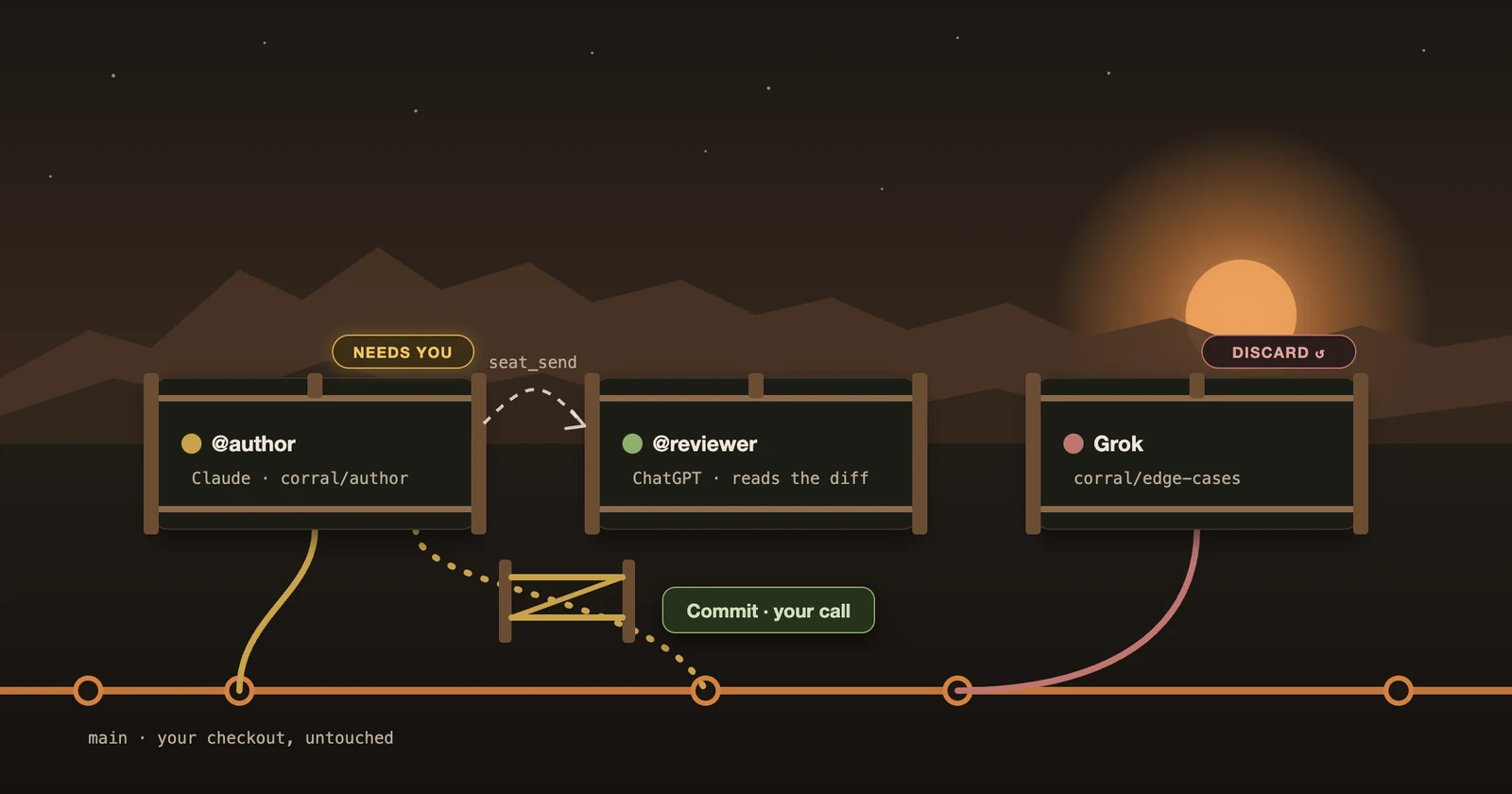
In September the lanes learned to talk. That fixed second opinions. It didn't fix the bigger problem with running several coding agents: they overwrite each other, you shuttle diffs between them by hand, and their questions hide in the last line of a long reply.
The last month of Corral Light went after all three.
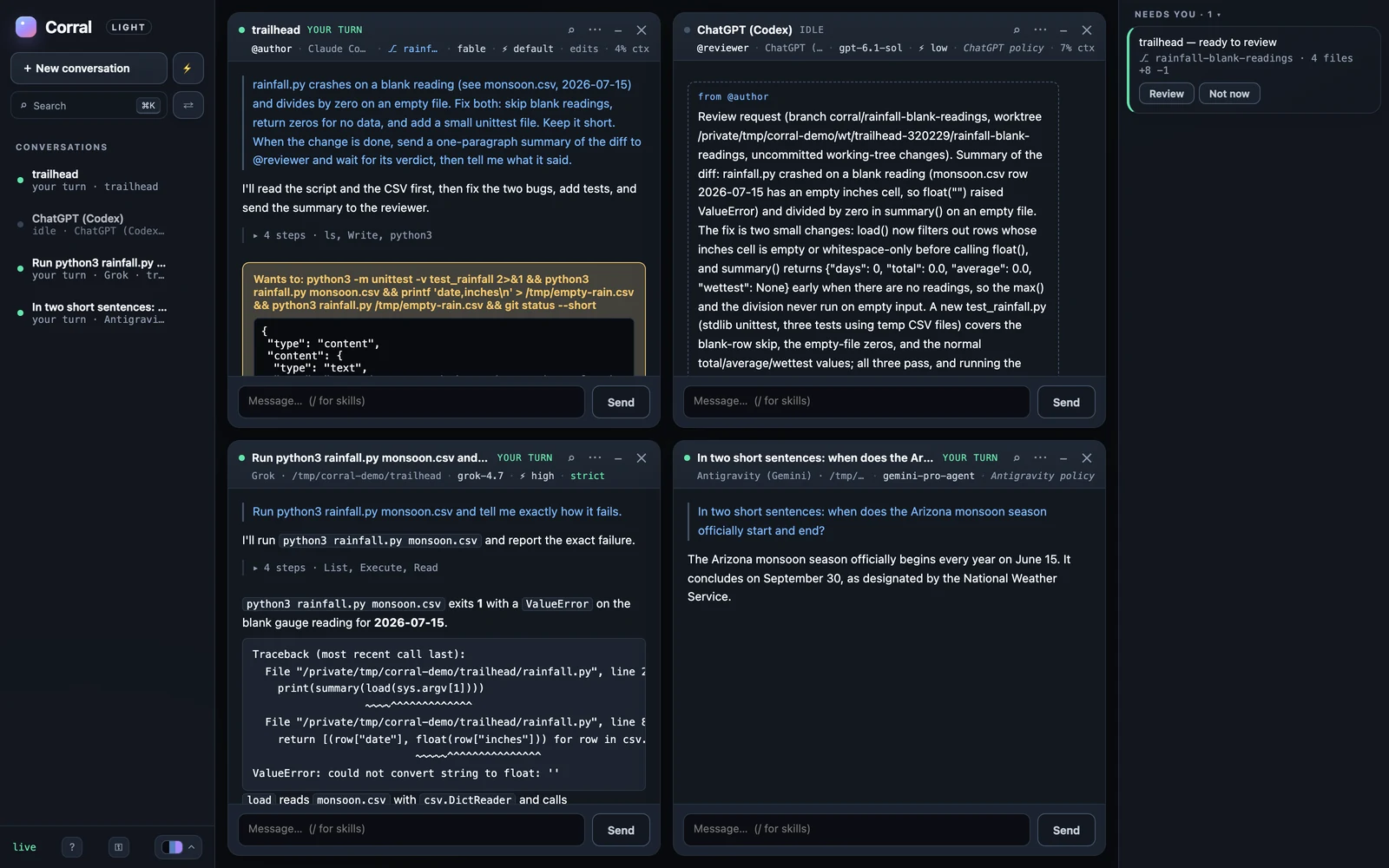
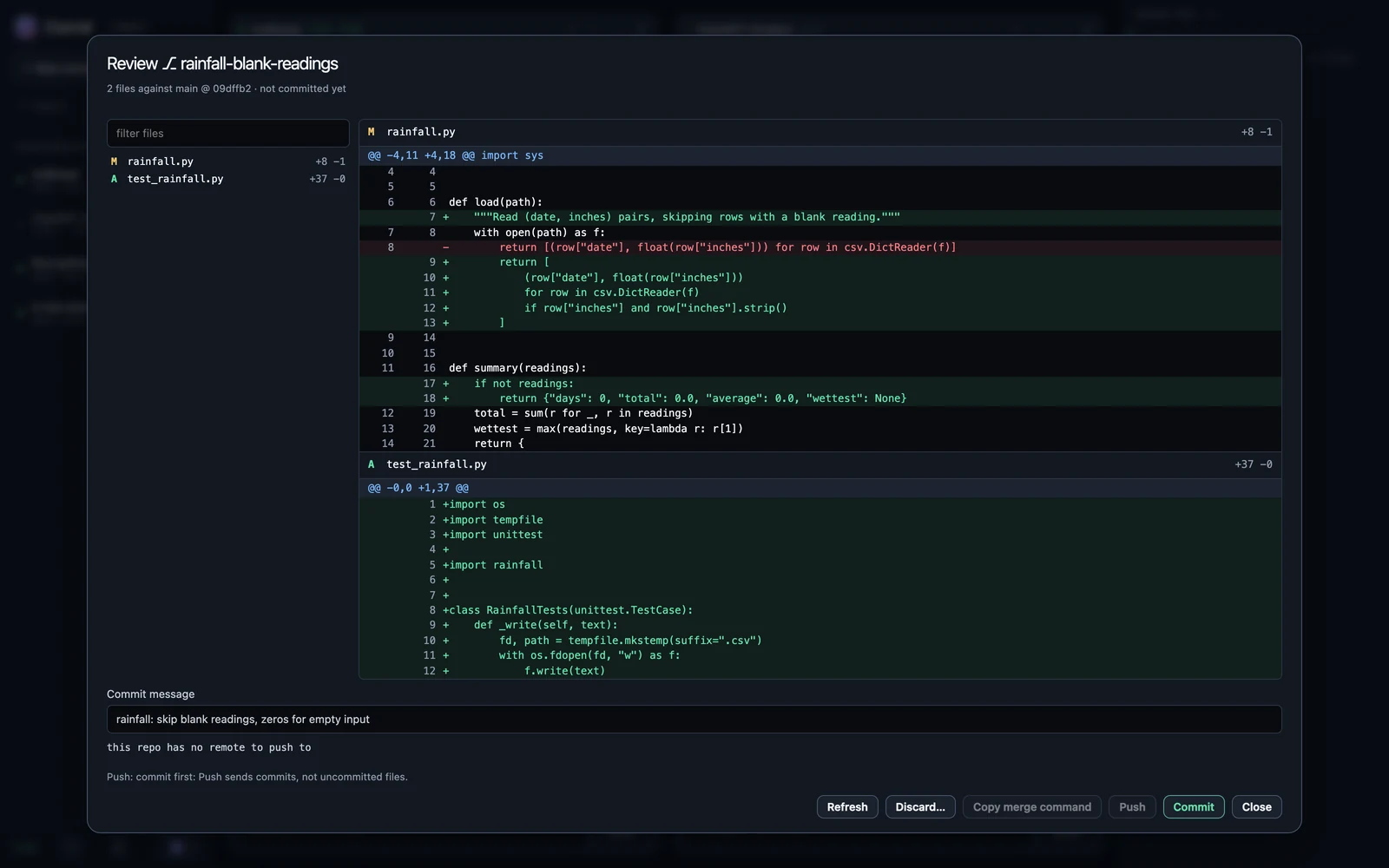
Each agent gets its own branch. Tick Own branch and the agent works in its own git worktree. Your checkout is never touched. When it's done, you review the diff, then Commit, Push, open a pull request, or Discard. Discard keeps a recovery copy.
Agents hand off by name. Call one pane @author and another @reviewer, and the author can send its work across and wait for the answer. A hop limit stops two agents from looping forever.
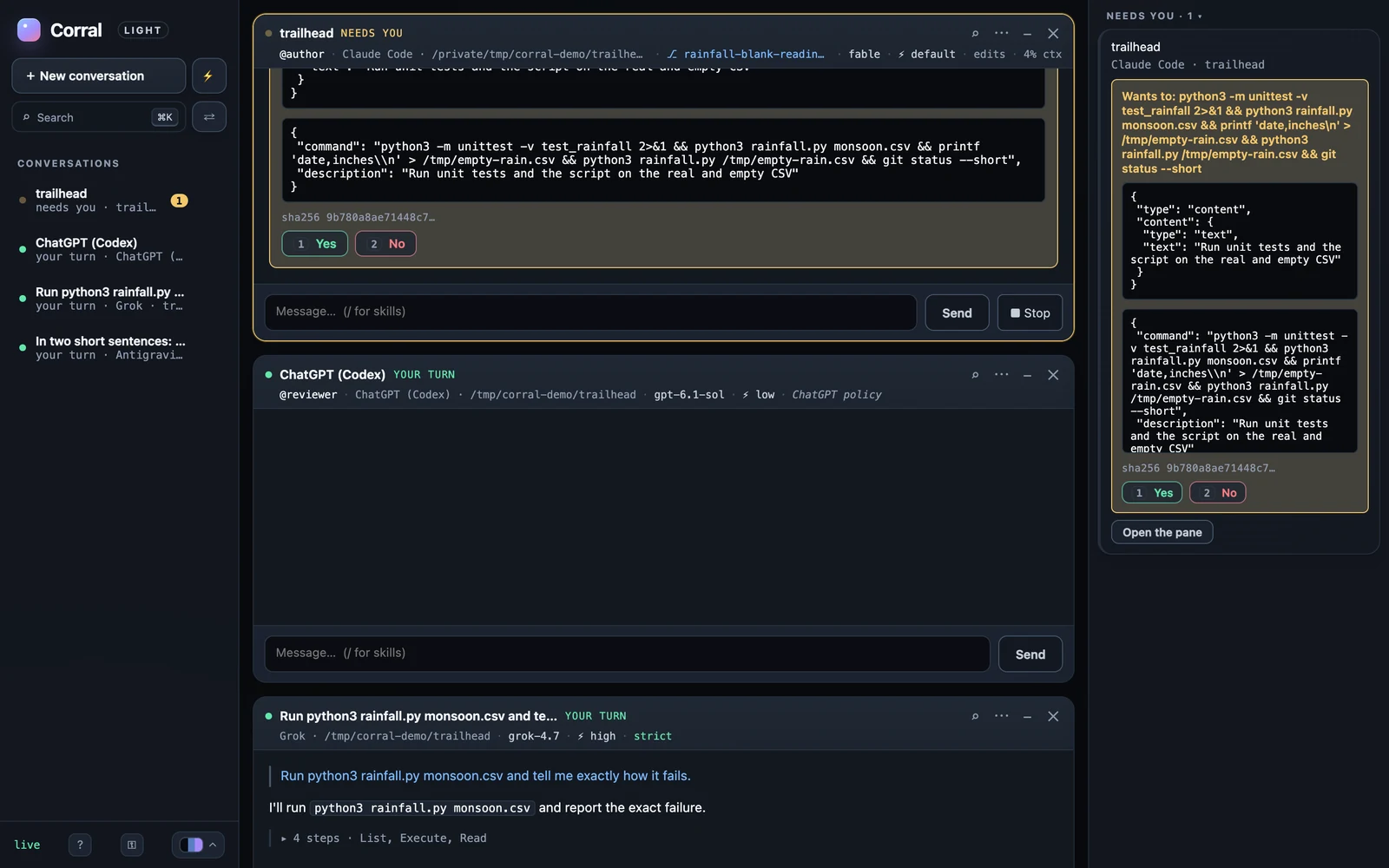
A pane that needs you says so. An agent's question flips its pane to needs you. Start ten agents at once and they open minimized, surfacing only when one wants you.
Also new: scripts can ask any lane for a second opinion on the subscription you already pay for, a saved rig brings your whole team back with one command, and conversations survive a restart.
The screenshots come from a live demo session on a scratch repository.
How I tested it
The branch feature is the riskiest thing I've shipped in Corral. It runs git inside your repositories while an agent is also running git. Bugs there don't crash; they lose work quietly.
So Corral tested Corral. Claude wrote the feature. GPT, Grok and Gemini each got a private copy and one instruction: prove a way this loses someone's work. I fixed what they proved and sent it back.
It took twelve rounds. Every round through the eleventh found at least one blocking bug, including:
- Staged work could vanish if the hub was killed mid-commit and restarted.
- Discard could lose a race, leaving an agent awake inside the trash folder and still writing.
- A confirmed push could land in a different repository than the one on screen, via chained git URL rewrites.
No single model found them all. GPT went deepest on state, Grok kept finding new ways to misdirect a push, Gemini signed off early. That spread is the argument for a panel. Round twelve found no blocking bugs, and it shipped October 3.
The loop I run now
1. Ask every lane first, so I know whether the question has one answer or several.
2. Give the author its own branch.
3. Name a reviewer from a different vendor, with different blind spots, and let the author hand off.
4. **Work on something else until a pane says needs you.**
5. Review the diff, then Commit or Discard. Every push waits on me.
6. Save the team as a rig for tomorrow.
The judgment stays mine. It just moves to where it's cheap: a diff on screen, a permission card, a flagged question.
Corral Light runs on your own machine with the subscriptions you already have. On Linux it's one pasted line; macOS works by hand today. The code and all twelve rounds of review are at github.com/cvp1/corral-light. Try the author-and-reviewer loop and tell me what your panel catches.