Two Rivers
Four headwaters, two parents, one family — from a boy stepping ashore at Elizabethtown in 1665, another at Québec in 1652, and a third leaving a Flemish village about 1890, down the length of the frontier, to a ranch in Arizona.
This family is made of two rivers, and each river is made of rivers. Mom's rises in a Wisconsin lead-mining town and in an indentured boy stepping ashore at Québec around 1652; it runs through the Sierra gold camps, a wheat farm on Thorn Creek, Idaho, and the Grand Ronde reservation, and reaches Seattle. Dad's rises in a farmhouse on the Kalverstraat in Zulzeke, East Flanders — where a farmer died at forty-four and the four-year-old who would cross an ocean was standing in the house — and in a Pennsylvania-German family that came down into Ohio and made locomotives at Lima; it comes to Seattle straight. They meet in King County in 1967, and everyone downstream of that meeting is us.
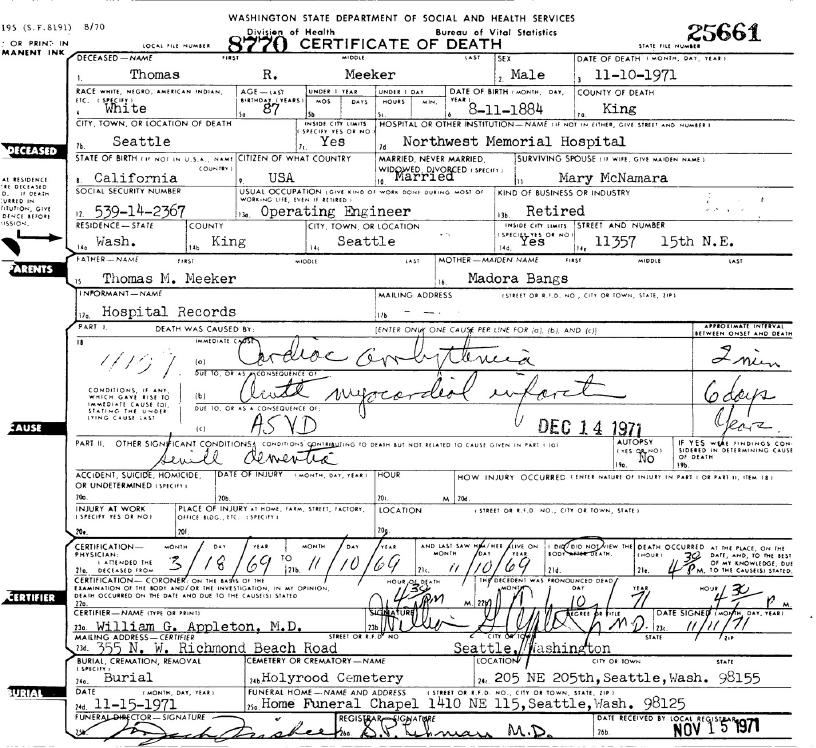
The Meeker half of it runs a very long way upstream. Thomas M. Meeker, who spent thirty years in the Sierra gold camps, was the son of Jonathan D. Meeker — soldier at twenty, justice of the peace at thirty-five, gold miner at forty, schoolmaster at fifty, lawyer at sixty. Jonathan was the son of Moses Meeker, who built the first lead smelter at Galena and whose estate file names him among the heirs. And behind Moses the line carries four more generations back to the William Meeker who came ashore at Elizabethtown, New Jersey in 1665 as one of the original Associates — the same colonial family that produced Ezra Meeker of the Oregon Trail, by a different branch.
The Ohio half runs just as far, and until this summer none of it had been read. Grandma Janis's father was Henry Clay Hammack, who signed his own draft card in 1918 as an assistant manager at the Lima Locomotive Works — grey eyes, brown hair — and who was the youngest of at least six children born at Lancaster to Michael Hammack and Nancy Wiseman. Behind them the names turn German: Mauck, Shambaugh, Wiseman, the Pennsylvania families who settled that corner of Ohio. And behind those, in a county history written in 1901 by Nancy's own brother, an account of Isaac Wiseman leaving Berks County, Pennsylvania after the Revolution — and of his son John, a Methodist preacher who, his grandson wrote, had wintered at Valley Forge. What follows is both of those stories, side by side.
The drawing
Four streams, two riversThe four headwaters
Nearest firstElizabethtown
Meeker · BangsThe Meekers, who came up from California to Seattle and married into a very Catholic family — and behind them a colonial New Jersey line that may or may not reach the Elizabethtown Meekers of 1665.
Immaculate High School, then Seattle University — religion and drama, where she met Vilas. Six children, thirteen grandchildren, fifteen great-grandchildren. Cared for at home by her children after a stroke in 2007. Buried at Holyrood.
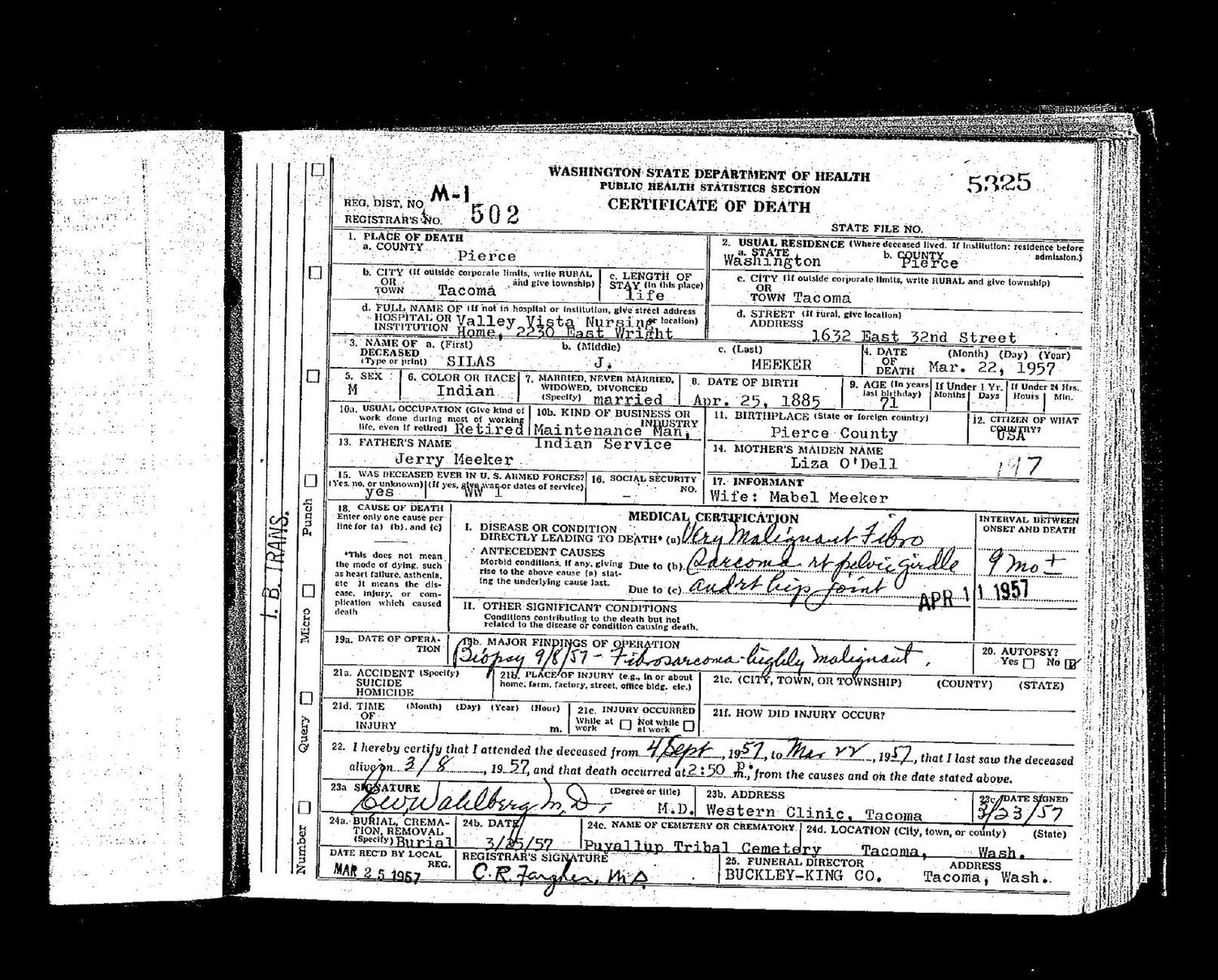
Your grandparents, Mom — my great-grandparents. Thomas was born in
the California diggings in August 1884, one of eight Meeker boys, and he was about
twelve when the whole household went north to the wheat farm on Thorn Creek. Somewhere
between that farm and this city he became an operating engineer — a man
who ran the machines that built Seattle — and that is still the trade written on
his certificate the day he died, retired, at eighty-seven.
He married Mary McNamara, and she is where the Irish comes into this family the
second time. They were Immaculate and Holy Names and Seattle University and Holyrood
people, the whole Catholic circuit of north Seattle — which is the only reason
Patricia was ever in a room with Vilas Dowd. They lived it as well as attended it:
his last address was on 15th Avenue NE, up in the north end, a few miles down
the same road as the ground he was buried in.
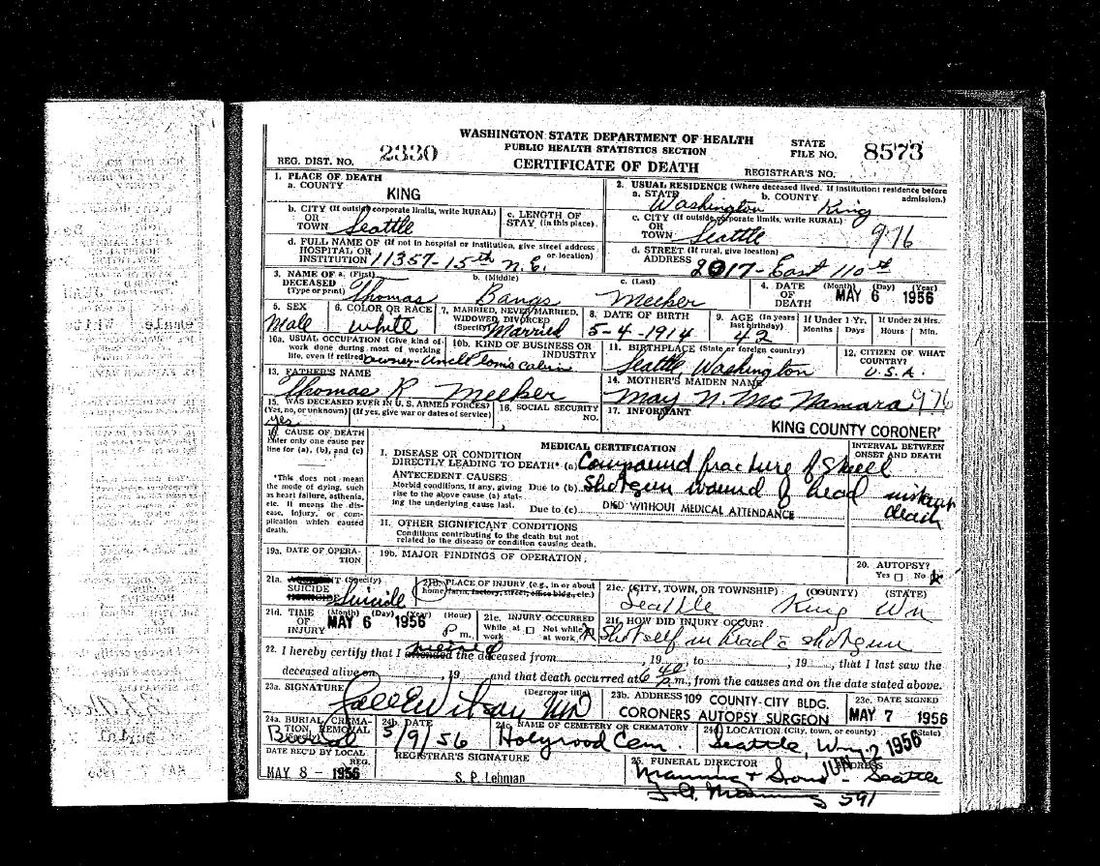
He buried a son. Thomas Bangs Meeker, named for his grandmother Madora, died at
forty-two in 1956; his father outlived him by fifteen years. Thomas lies at Holyrood,
and Patricia joined him there thirty-nine years after.
Thomas left Wisconsin as a young man for the Sierra County gold
country and stayed thirty years — Pine Grove, Howland Flat, Loyalton — mining
in the same county as Daniel Bangs, and on Christmas Day 1866 he married the
miner's daughter. She was sixteen; he was twenty-nine. The county register has the
whole of it: a licence taken out a few weeks before, then a line in the recorder's
hand certifying that Thomas M. Meeker and Medora Bangs “were joined in marriage
by me in the County of Sierra on the 25th day of Dec. 1866” — a minister,
not a justice — and filed at Downieville the following January. They raised fourteen
children in the camps: a first daughter lost in infancy, then Henrietta Rose,
Edward Lee, Effie, Charles, Mary Elizabeth, Lottie, Alice Elvira —
named for his mother — John Denman — carrying a name the New Jersey
Meekers had used for generations — Thomas Robert, Horace, Henry, Louis and Herman.
About 1896 the whole household went north to a wheat farm on Thorn Creek, Latah
County, Idaho, following Medora's brother Henry, who had settled there sixteen
years before. Thomas died at Moscow; Medora went on — to Medicine Hat,
Alberta, and at last to Seattle, where she died of heart trouble on 2 November
1918, aged 68. They brought her back to Moscow to be buried. Her children by then
were scattered the way the West scatters people: Alice Sparks in Seattle,
Effie Fuller and a Mrs. Alex Hamilton at Orofino, Charles over the
mountains at Leavenworth — the next town to Peshastin, where his aunt Hattie lived.
Moses's son, Thomas's father, and the reason this line reaches New
Jersey. The family remembered him as a schoolteacher; that was one job out of a
working life that ran the length of the frontier. He was born in New Jersey about 1811,
before his father left for Cincinnati, and at about twenty he was a private in
Captain Duncan's company of Illinois volunteers in the Black Hawk War —
which fixes his age better than any census does, because a boy of thirteen does not
muster. In January 1841 he bought land at the Mineral Point office on the same day
his father did, three hundred and twenty acres in one stroke. From 1846 to 1848 he
sat as a Justice of the Peace at Franklin, Iowa County, taking
acknowledgements and marrying people and signing his name out in full in the deed
book each time — which is how we know the initials belong to a Jonathan. In
November 1848 the county made him an election inspector for the Blue River
precinct.
Then the gold. A Jonathan Meeker and a Warner Meeker worked Nelson Creek in Plumas
County, California with the outfit the county history calls the Wisconsin
company — almost certainly him and his elder brother — and in
February 1852 his name went up on the claim notice that became Taylorville. He was
still in California in December 1856.
By June 1860 he is back at Boscobel, teaching school, living in the house his
married daughter Mary kept on a milliner's trade, with nineteen-year-old Henrietta
teaching beside him. He married again in 1862, and the village put him to work:
Town Clerk from 1866, Police Justice in 1867, and Village
Treasurer for seven years after that. The 1870 census finds him alone at
fifty-nine, next door to the town doctor, his trade written down by then as
Lawyer. Soldier at twenty, landholder at thirty, justice at thirty-five,
miner at forty, schoolmaster at fifty, lawyer at sixty. After 1873 he simply stops
appearing in the record.
He was Moses's son, and he was Thomas's father. Thomas was thirteen in Margaret
Elvira's house at Mineral Point in 1850; thirty years later, in a California gold
camp, he told a census taker his father was born in New Jersey and his mother in
Indiana — Jonathan and Margaret Elvira exactly, as a pair.
Thomas's mother, and she has been hiding on this page under half her own
name. Elvira was her middle name, and the one she went by. That is why the
record seems to hold two women: the census taker at Mineral Point in 1850 wrote down
what the household called her, Elvira, while the clerk who drew up the 1857
deed wrote the legal name, “Margaret E. Meeker”, the way a deed
always does. One woman, two hands, two habits.
She was an Indiana girl who raised her children at Mineral Point, a
Cornish-and-Yankee lead-mining town, and raised them largely alone: in 1850 the
census found her keeping the house herself, Jonathan away, with Mary, Thomas and
Henrietta around her. A last son, George, came in 1852. And when Jonathan was
in the California diggings she was not simply waiting — in December 1856 he
signed a power of attorney over to her, and in April 1857 she sold his forty
acres in Grant County herself, acknowledging the deed in Iowa County as his
attorney in fact and in her own right. A married woman doing that in
Wisconsin in 1857 was doing something most married women were never handed.
She was gone by June 1860. Her children carried her: Thomas named a daughter
Alice Elvira, born in a California gold camp about 1879.
Jonathan's father — his own estate papers say so — and the man who brought the Meekers
west. Born at Newark, he manufactured white lead in Cincinnati, saw the Fever River
country in 1822, and the next spring took a keel-boat with a party of forty-two
down to what is now Galena — eighty-nine days on the water. He built the first
smelter there, captained a company in the Black Hawk War, sat in the territorial
legislature, was a delegate to the 1846 Wisconsin constitutional convention,
and lived at Mineral Point — the town where Margaret Elvira raised Thomas. Meeker's
Grove is named for him; his portrait hangs in the Wisconsin Historical Society; he
wrote the standard first-hand account of the lead rush himself.
He is on this page because his own estate file puts him
here. When he died in July 1865 his widow filed a petition in the La Fayette County
Court listing every person interested in the estate, and the second name on it is
“Jonathan D. Meeker, who resides in the County of Grant” —
our Jonathan, in Boscobel's own county, named as an heir beside Warner in California,
John in Richland County and Edwin in Kansas. That one sentence is what opened this
road.
Behind Moses, a published Meeker genealogy runs back through Capt. Jonathan Meeker
of Lyons Farms (1744–1805) to the William Meeker who landed at
Elizabethtown Point in 1665 as one of the original Associates — the same
colonial family that produced Ezra Meeker of the Oregon Trail, by a different
branch of it. Nine generations from a landing at Elizabethtown Point to a smelter on
the Fever River, and four more from there to Seattle.
Medora's parents, and the Gold Rush in a single household. Daniel of Michigan and Sarah of Vermont married in the East; Medora was born in New York in June 1850; and by 1857 the family was at Downieville, Sierra County, where the census taker wrote Daniel's trade in one word: miner. He came for the gold, and he stayed with it — a decade later the family was one county north at Quartz, Plumas County, still in the diggings, with two more daughters, Ella and Hattie. Five children in all that we can name: Medora, Henry, little Charles — who appears at age one and is never seen again — Ella, and Hattie, who grew up to be Mrs. Hattie Young of Peshastin, Washington.
Medora's brother, born in the diggings, and the man who chose the ground this family stood on for a generation: in 1880 he took up land on Thorn Creek, near Moscow, Idaho, and about sixteen years later his sister's whole family followed him there. Latah County sent him to the Idaho legislature three times, and his work helped establish the College of Agriculture at the University of Idaho. He died suddenly at his farm in the Raft River country in 1914 and was brought back to Moscow to be buried — as his sister would be, four years later.
Grand Ronde
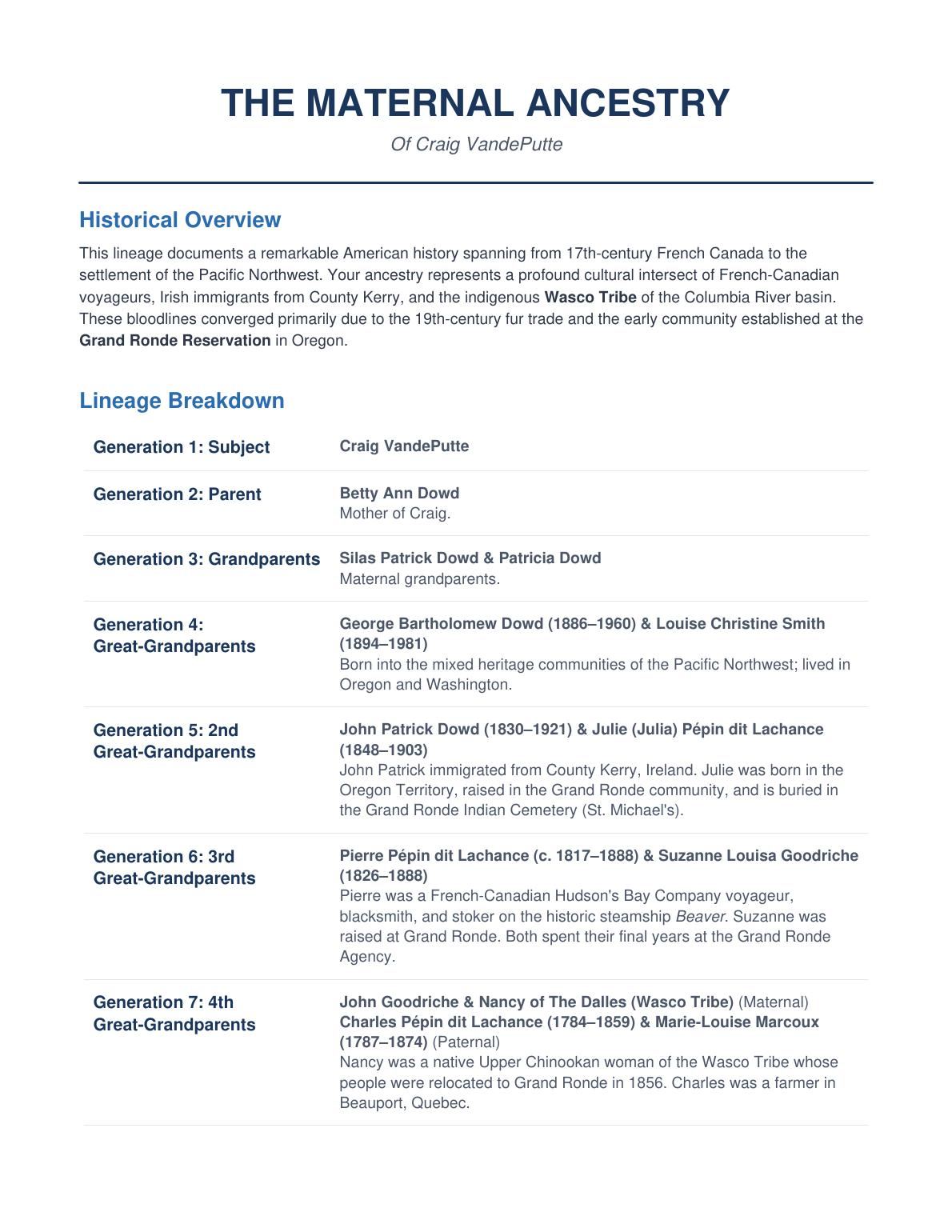
Dowd · Pépin · GoodricheThe Dowds, who reach back through Grand Ronde to Québec and to County Kerry — and through Nancy of The Dalles to the Columbia River itself.
A twin — his brother was Vincent. Both scholarship athletes at O'Dea and Santa Clara. He taught at O'Dea and worked for Standard Oil, and died of multiple sclerosis. His name is on the 1939 King County marriage index and in Patricia's obituary.
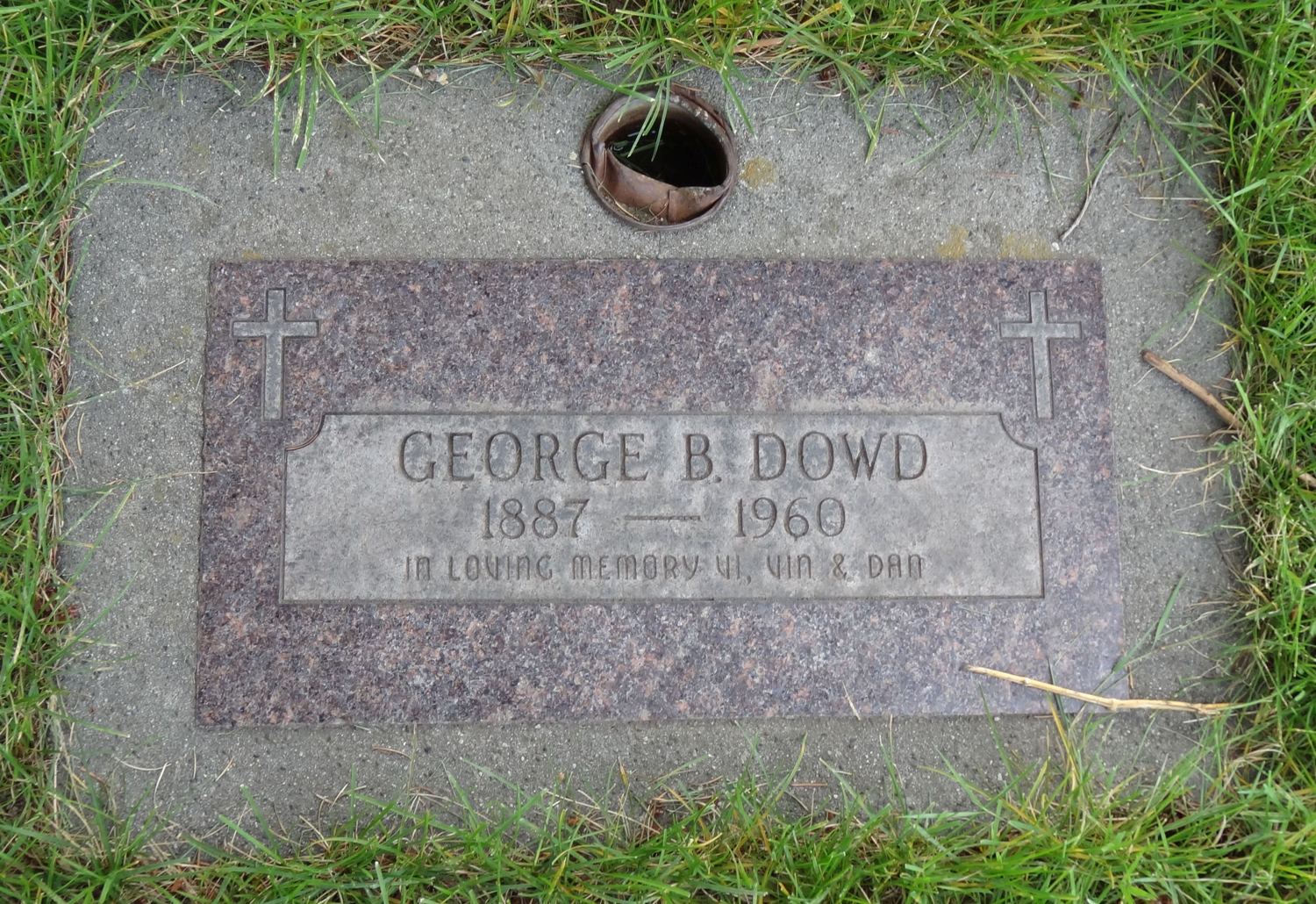
Vilas's parents. George was Julia's son — an 1886 baptism and a 1904 probate say so — and he married Louise Christine Smith. Through him this side of the family reaches back to Grand Ronde, to Québec, and to County Kerry. He died in Seattle in the spring of 1960 and was buried at Holyrood — the same Catholic ground where Patricia and her father Thomas R. Meeker lie, three generations of this page in one cemetery. His own stone and his 1942 draft card both put his birth at St. Paul, Oregon in September 1887; the baptism that proves whose son he was is an 1886 one. Nobody has yet reconciled the two.
Julia was born in Oregon Territory, raised at Grand Ronde, and buried in the St. Michael's Grand Ronde Indian Cemetery. Her husband came out of County Kerry in 1830 and came the whole way across a continent to marry a voyageur's daughter on an Oregon reservation. This is where the Irish enters the family the first time; the McNamaras bring it in again three generations later.
Julia's father, and the French-Canadian half of that marriage. A Hudson's Bay Company voyageur, then a blacksmith, and a stoker on the steamship Beaver — the first steamship on this coast, which is a specific and slightly astonishing thing to find a great-great-grandfather doing for a living. He married Suzanne at St. Paul on 8 January 1844 and died at the Grand Ronde Agency in 1888, the same year she did. Behind him the family goes back into Québec, five generations of it, to Antoine.
Julia's mother, and the woman this whole side of the family runs through.
Her father was John Goodriche; her mother was Nancy, a Wasco woman of
The Dalles — which is where the Wasco blood comes into this family, and why
Grand Ronde is the ground it all settles on. She married Pierre at St. Paul on
8 January 1844, and the two of them died in the same year, 1888, at Grand
Ronde.
She was either a small child or a newborn when her father drowned — the family
paper puts her birth in 1826, the Hudson's Bay sheet has John Goodriche going
into the river in 1830 with “his daughter Susanne days old at his
death.” Either way she grew up without him, and either way she was very young
when she married Pierre.
Suzanne's mother and father, and the reason Grand Ronde is in this family at all — Nancy's people were removed there in 1856, and the reservation is the ground the whole of Mom's father's side settles on. The census keeps score of it in its own blunt way: Julia was recorded as one-quarter Wasco in 1900. John Goodriche drowned at The Dalles about 1830 and left Nancy with an infant daughter.
The far end of this stream. He crossed around 1652, roughly fifteen years old, as an indentured servant, and married Marie Teste at Notre-Dame de Québec in 1659, and died at Sainte-Famille on the Île d'Orléans in 1703. Five generations of Québec sit between him and Pierre — a hundred and sixty years of the same family on the same river before one of them walked out of it and went west with the fur trade. The parish books on the Île d'Orléans are where the rest of that stretch is written down, and they are the next thing to read.
Flanders
Vande Putte · DesmetA Flemish family out of one East Flanders village — Zulzeke, near Ronse — that came straight to Seattle, skipping the Belgian colonies in Detroit and Minnesota entirely. Octave went first: by May 1888 he was buying lots in Gilman Park, now Ballard, and the rest followed within a few years. He is the one this side of the family comes down from.
Dad. A Seattle Police lieutenant, badge 2246: joined 21 March 1962, served in Homicide among other units, retired 8 January 1986. He went by his middle name — he signed his own mother's death certificate as "P. Craig Van De Putte."
He married twice. Barbara Nilsen was first — they married in King County in 1958, when she was not yet twenty — and she died at University Hospital on 17 January 1966, of lupus, aged twenty-six. She was the daughter of Erling Nilsen and Clara Nass, and she is buried at Evergreen. He married Betty Ann Dowd in King County the year after.
Dad’s older sister, and for a long time the only person on this side of the family we could not put a date to. She married twice — first a Macaulay, who was Marylyn’s father, and then, in February 1954, Kenneth Morgan. Four children in all: Marylyn, Aaron, Kurt and Stephen. She worked for King County as a section supervisor, and the family lived out in the SeaTac country south of the city.
She died of cancer at Group Health on the thirtieth of December 1988, fifty-six years old, and was cremated at Washington Memorial Park. Ken signed the certificate.
A clerk in 1988, filling in two boxes near the top of her death certificate, wrote her father as Homer Van de Putte and her mother as Janice Hammack. That is how we have her at all — not from anyone’s memory, but from two lines on a form, which put her in this family beyond argument.
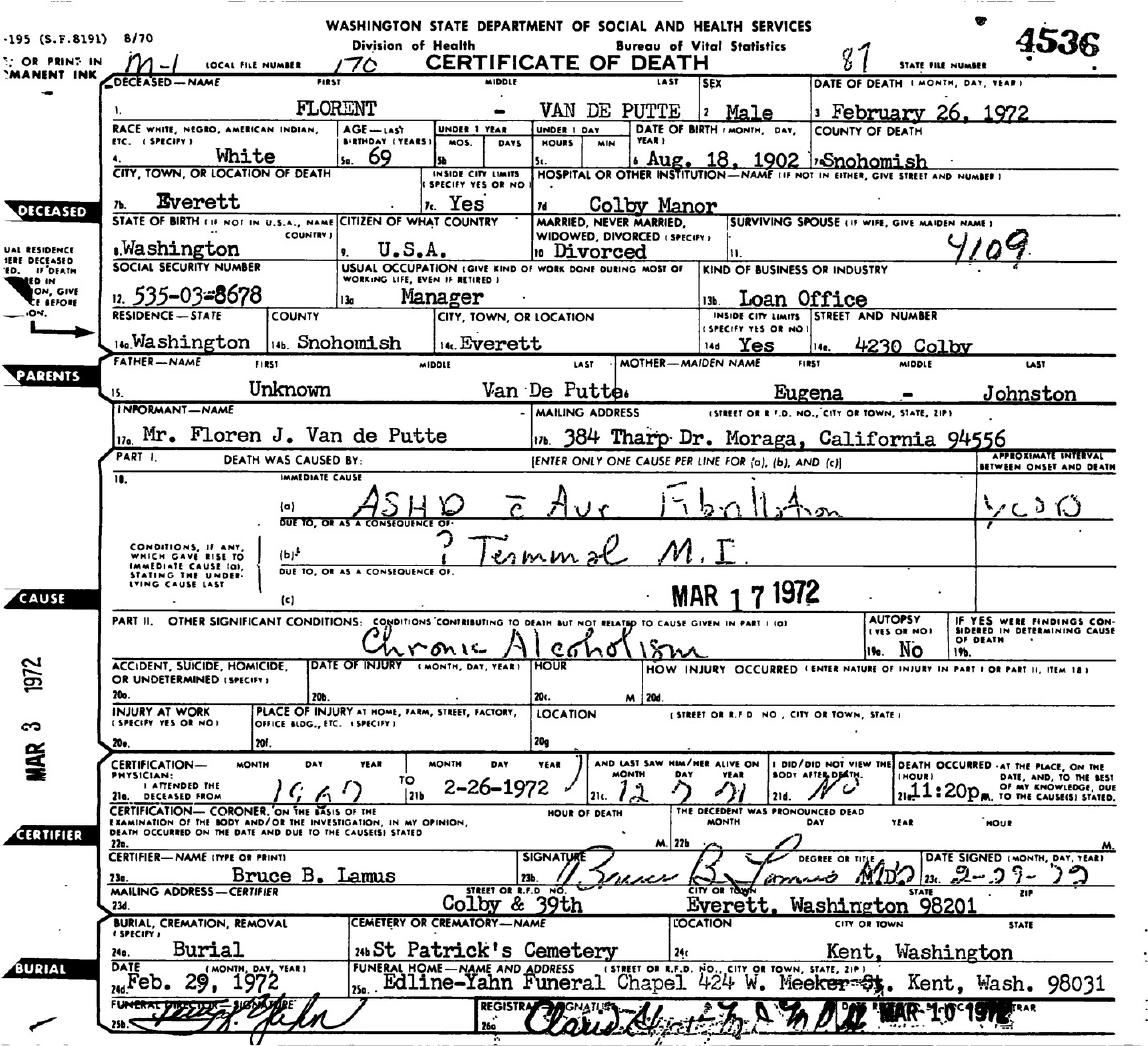
Grandpa, and the one man on this page nobody living met — until this summer, when four documents gave him back. He was Octave’s son, born in Seattle in the August after his parents buried three children in eight days. He was five foot ten and a hundred and sixty pounds, with blue eyes and brown hair.
He was living in San Francisco when he married Janis Carolyn Hammack — not in a church and not in the Midwest, but in front of a justice of the peace at Tumwater, sixty miles south of Seattle, on 22 July 1931. She gave her occupation to the clerk as Daddy’s girl. Joan was born six months later; Dad came in 1938.
On the morning of 16 February 1942 he walked into Local Board No. 4 on Harrison Street, registered for the draft with the rest of the country, gave his employer as the Seattle-Tacoma Shipyard, named his mother at Kent as the person who would always know where he was, and signed his name. At noon he died on the sidewalk at Fourth and Pine, of a coronary occlusion, thirty-seven years old. He was buried three days later at St Patrick’s, in the same ground as his father and the three children of 1904. Janis was thirty-four, with Joan at ten and Dad at four, and she was a widow for forty-one years.
Dad’s great-grandfather, and the one who went first. He was born in the Kalverstraat house on 12 May 1868 — a sister, Celina, had come in 1866, then Octave, then Joseph Henri in 1870, then Camille Gomar — and he was across the water before he was twenty. By May 1888 he was buying six lots in Gilman Park, now Ballard, and he was trading again in 1890. He married Eugenia Johnson — Jennie, a Michigan girl — at Spokane in 1892.
Then the winter of 1904. They lost three children in eight days at their house on East Olive Street — Philip, five; Frank, eight; Jeanette, nine. They lie together in one plot at St Patrick’s, out at Kent. That August Jennie bore another son, and they named him Homer: Dad’s father, born into a house that had just been emptied.
The marriage did not survive it. By 1910 the two boys who lived, Florent and Homer, are in a relative’s household and written down as nephews; somewhere before 1920 Octave and Jennie divorced, and she married Henry Schatz and went out to Kent, where she was still living when Homer named her on his draft card in 1942. Octave died on Mercer Island on 30 April 1937, a labourer, sixty-eight, and his certificate says divorced. It also names his own father and mother — Philippe Vande Putte and Melanie Desmet, of Belgium — and that one line is what ties this whole side of the family to a single village. He was buried with his three children.
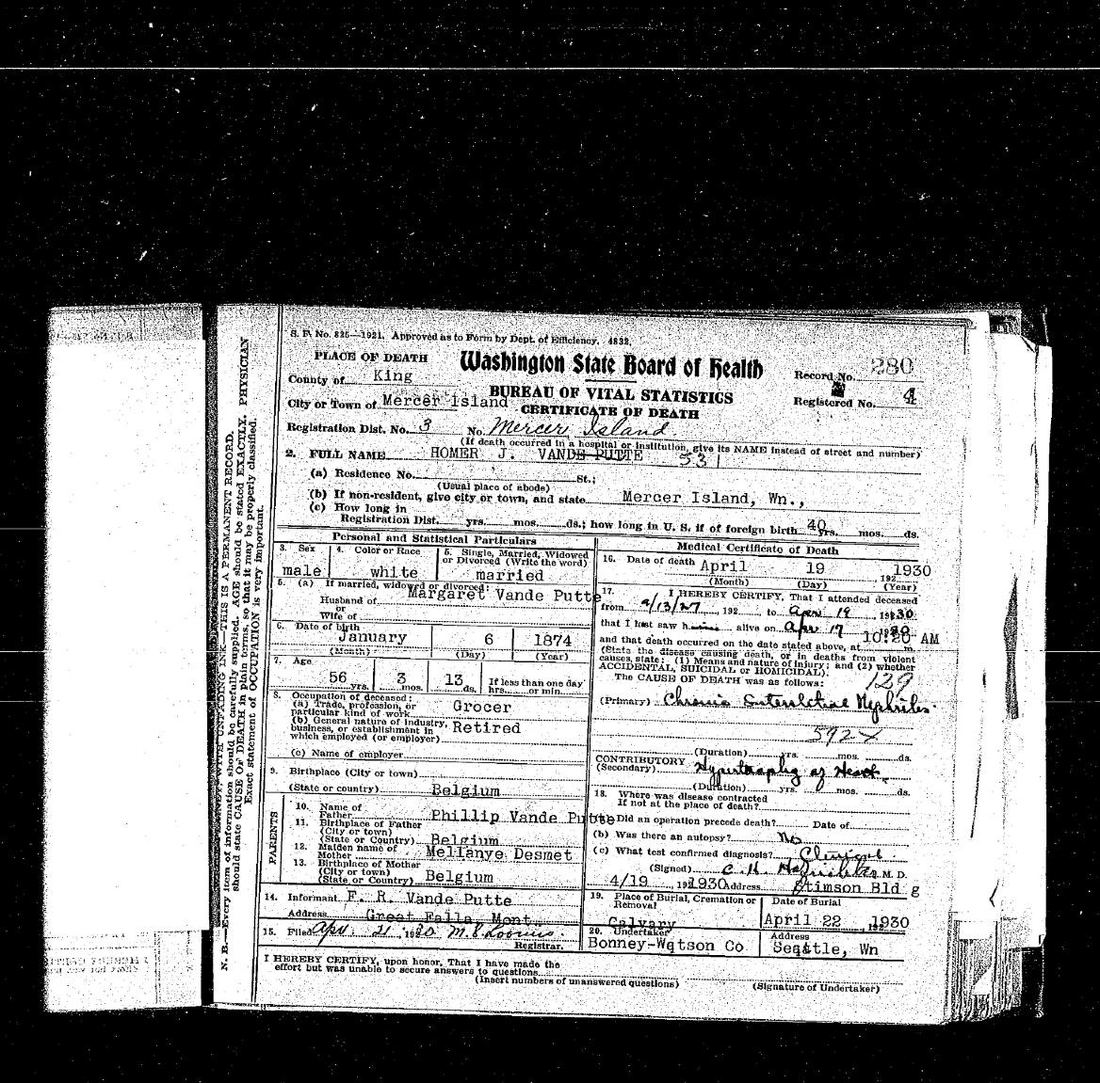
His younger brother is why this page was wrong for a long time. Camille Gomar Vandeputte was born at Zulzeke on 5 January 1873, eight weeks after their father died; he came out to Seattle in his turn, married Marguerite Comiant in King County in 1900, kept a grocery, and died on Mercer Island in 1930 — the same island his brother would die on seven years later. He is buried at Calvary. Gomar is a Flemish name with no English form; Homer is what it becomes in the mouth of an American clerk, so he died Homer J. Vande Putte. And Octave had already named a son Homer. There were two Homer J. Vande Puttes in Seattle, uncle and nephew, thirty-one years apart.
The far end of the Flanders stream, and for a long time only two names on a single sheet of paper — Homer J.'s 1930 certificate, written down by a clerk on Mercer Island half a century and an ocean from wherever they were standing when they had him. They no longer rest on one sheet. Octave Vande Putte died in Seattle on 30 April 1937 and his certificate names the same father and the same mother. Two brothers, one couple behind them.
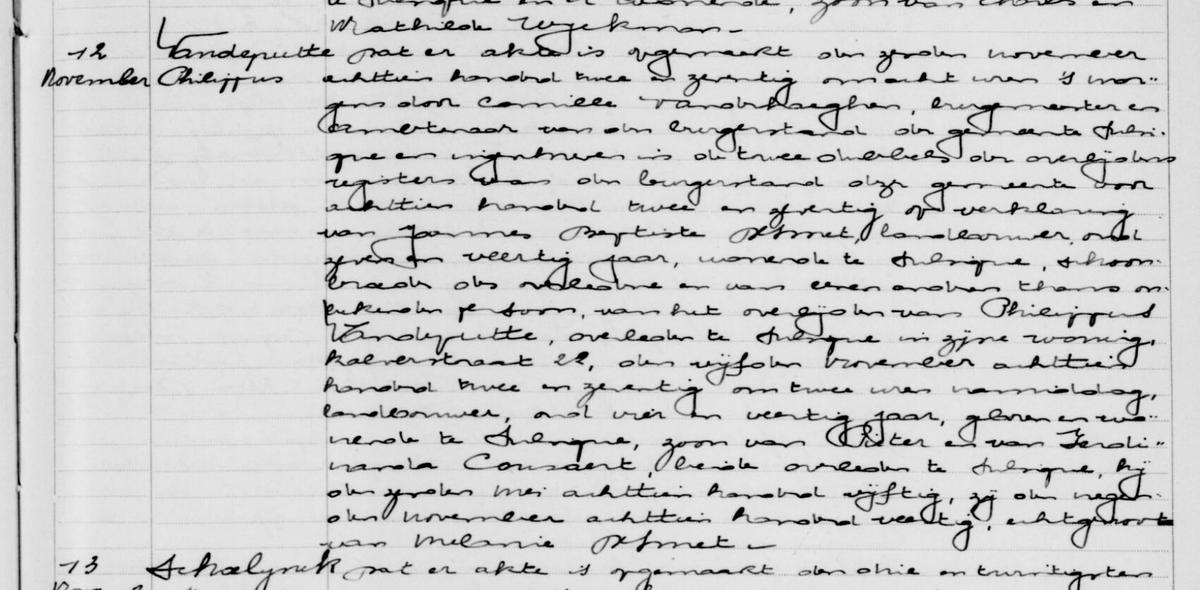
They were married in the village on 9 August 1865, at five in the evening, and the marriage act is the most generous document on this side of the page: it gives Philippe’s own birth as 17 January 1827 at Zulzeke and Melanie’s as 14 September 1833, in the same village. He was a farmer, thirty-eight; she was thirty-one. Both of them had already buried a father.
His parents were Pieter Vandeputte and Ferdinanda Cousaert, both dead before the wedding. Hers were Eugenius Desmet, dead since 1859, and Regina De Keyzer, who was sixty-four and stood in the room to give her consent — the only one of the four grandparents alive to see it. Melanie outlived Philippe by twenty years and died at Meulebeke in 1892.
Philippe’s parents, and the oldest people on Dad’s side of this page. We know them the way you know anyone who survives in one sentence of somebody else’s paperwork: two of their son’s documents name them, place them in the village, and give their dates. Ferdinanda died on 9 November 1840 — both papers agree on that. Pieter died on a sixth of May, and the two papers do not agree on which one: his son’s marriage act of 1865 says 1858, his son’s death act of 1872 says 1850. The day and the month are the same in both. One clerk wrote one Dutch word wrong, and until somebody reads Pieter’s own act we do not know which clerk it was.
Set those against Philippe’s own dates and a shape comes out of them. He was thirteen when his mother died, and somewhere between twenty-three and thirty-one when he buried his father. He was dead himself before he was fifty, and his last son was born eight weeks later and never saw him. Three generations in one village, and in each of them a boy grew up short a parent.
Their own records are still in the Zulzeke registers, unread — a marriage somewhere before January 1827, and two death acts that would settle the year, give their ages and birthplaces, and put one more generation behind them.
Melanie’s parents, and new to this page — they come out of the 1865 marriage act, which had to account for all four parents before it could let the wedding happen. Eugenius was already six years dead. Regina was sixty-four, a farmer’s widow living in the village, and the act records her as present and consenting: she was in the room.
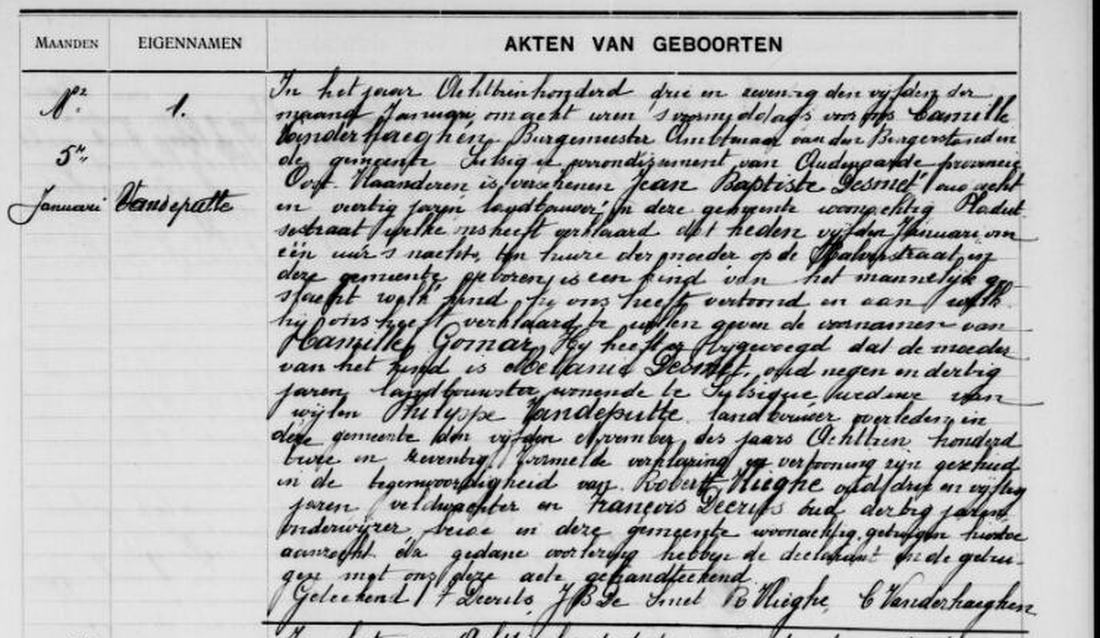
They also explain the man who keeps turning up. Jean Baptiste Desmet — who registers Octave’s birth in 1868, reports Philippe’s death in 1872, and walks to the town hall again in January 1873 to register the posthumous baby — is Melanie’s brother, and so their son. Three of the four Belgian documents on this page were declared by him. When the Vandeputte men were gone, the Desmets did the paperwork.
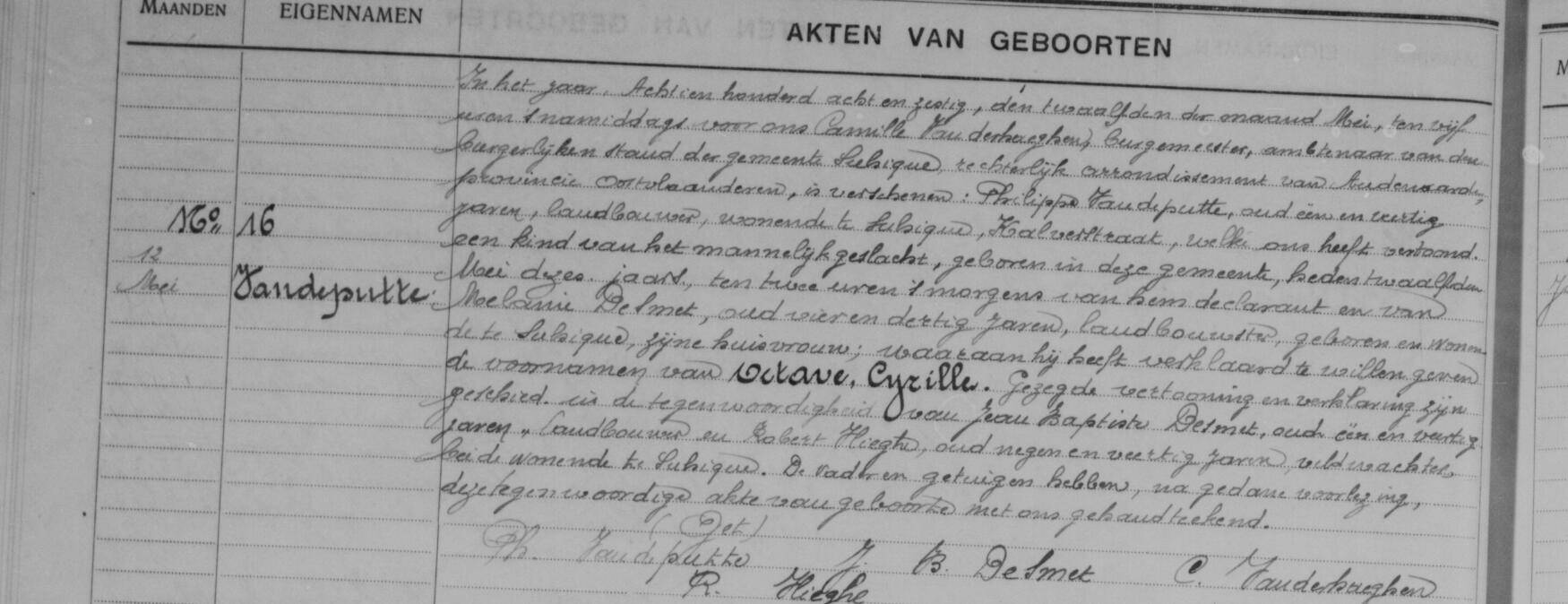
Zulzeke is a farming village in East Flanders, near Ronse, folded into Kluisbergen now. The family farmed on the Kalverstraat, and the street does both jobs in this story. On 12 May 1868, at two in the morning, Melanie had a son there and Philippe walked to the town hall the same afternoon to name him Octave Cyrille. Four years later, on 5 November 1872, at two in the afternoon, Philippe died in that house — Kalverstraat 22, forty-four years old. Melanie was pregnant when he died.
On 5 January 1873, at one in the morning, she had a son, and her brother walked to the town hall to register him — Camille Gomar, the last of them, born eight weeks after the funeral and into a house with no father in it.
But the stream this family came down runs through the other boy: the one born in that same room at two in the morning, five winters earlier. Octave was buying land in Ballard before he was twenty. That is the whole distance between this village and a Seattle shipyard — a farmhouse on the Kalverstraat, a farmer dead at forty-four, and a grandson who would sign his name one February morning and be dead by noon.
Octave was not the only one to come. Stanislas married Mary Van Bossche in King County in 1890; Frank and Octave turn up together at a south-county social in 1894. And the King County census of 1 June 1889 catches three Belgian-born Vandeputte boys on a single page out in the White River precinct, aged twenty, nineteen and sixteen. Octave’s age is right and Camille Gomar’s is right to the year; the middle boy is set down under an F, which is not the initial of the brother who belongs between them, and who he was is a question this page still cannot answer.
Van de putte is a Flemish habitational name — "from the well." It is thickest in West Flanders, but the register that matters here is one province east.
Ohio
Hammack · Richmond · WisemanThe line that met the Flemish one in Seattle. It runs back through Lima and Lancaster to the Pennsylvania Germans of Berks County — and to a Methodist preacher the family long believed had wintered at Valley Forge — a story the record does not bear out, and the end of this page says why.
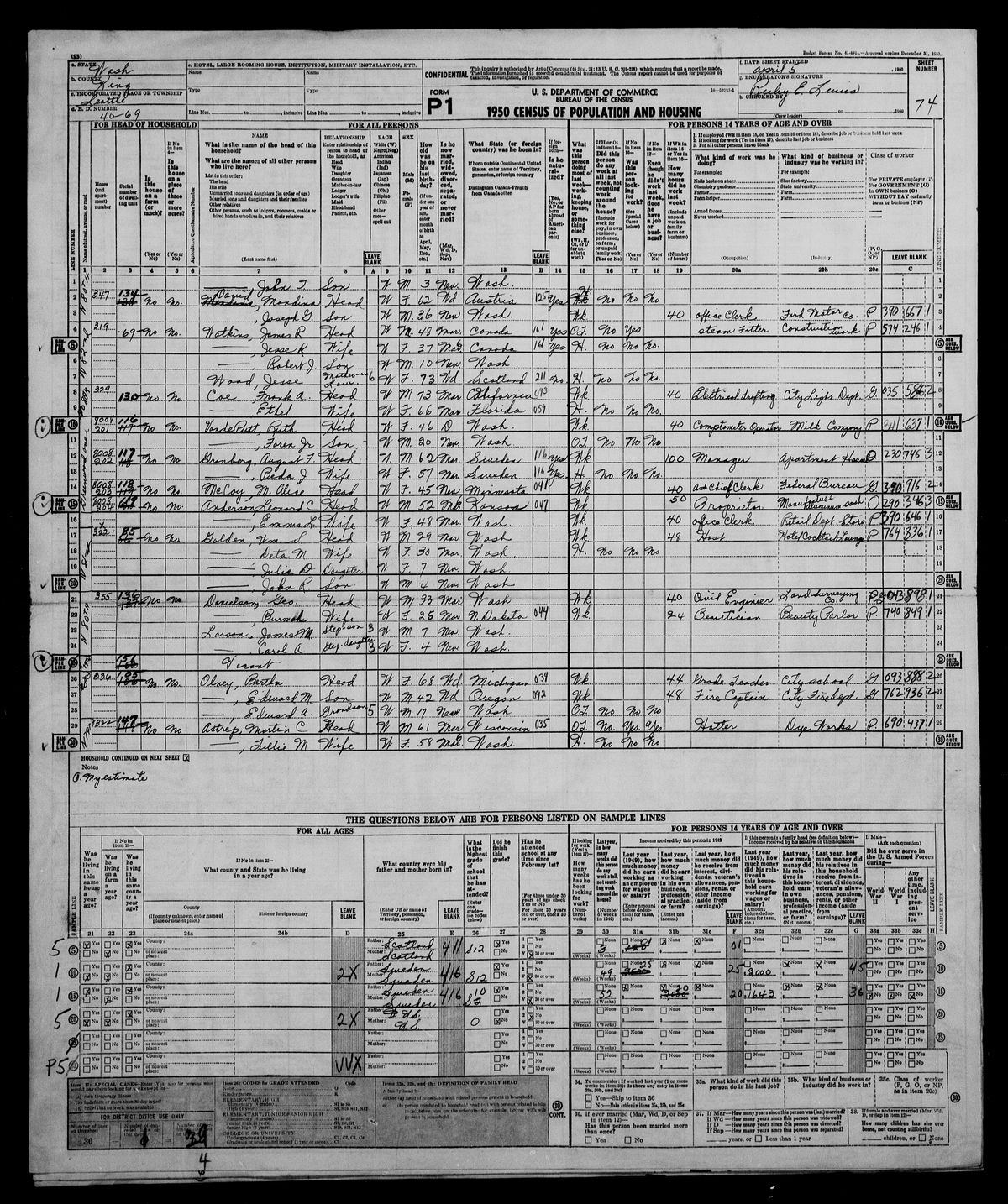
Grandma. A retired clerk who did appliance repair. She died at home of osteosarcoma and was cremated at Washelli. Her certificate is the document that settles the most: it names her husband — Homer Van De Putte — and her parents, Henry C. Hammack and Florence Richmond, of Ohio. She had been a widow since 1942 — forty-one years, in the house she died in. She had a sister, Pauline Elizabeth Hammack (1899–1994), who never married and was named for their grandmother.
Janis's parents. Henry was born at Lancaster, Ohio on the last day of October 1875; Florence in Ohio in 1877. They came out to Seattle around 1925 and took the house at 4903 Burke Avenue — the same house Janis would die in fifty-eight years later, and the address Homer gave on his draft card the morning he died. The two halves of Dad’s family were not just in the same city; they were under the same roof. Florence died there in 1929, the day after her fifty-second birthday, and Henry followed in 1948. Both of them were put on a train home to Lima, Ohio, to be buried. Their certificates name their own parents — Michael Hammack and Nancy Wiseman, Edward E. Richmond and Pauline Alexander. He signed his own draft card in 1918 in full: Henry Clay Hammack, assistant manager of the repair parts department at the Lima Locomotive Works, grey eyes, brown hair. He had started out a stenographer. He named his son Clay.
Henry's parents, and for a long time only two names copied off a coroner's file with no birthplaces beside them. They turn out to be real, and they are still in the ground at Forest Rose Cemetery in Lancaster, their headstones standing. Henry was the youngest of at least six — Charles, Edwin, Ella, Lizzie, Orrin and Henry — born to a mother of about forty-four, twenty-two years after the eldest. When his sister Ella died at Lancaster in 1931 the court wrote down where the family had got to: one brother on King Avenue, one in New Jersey, and Henry C. Hammack, of Seattle, Washington.
Michael's parents. The names are Pennsylvania German, like most of the names around Lancaster in those years — Mauck, Shambaugh, and Wiseman, which was very likely Weissmann before it crossed the Atlantic. This family carried mothers' maiden names forward as middle names, generation after generation, which is how a man born in 1800 comes to be called Shambaugh and a boy born in 1853 comes to be called Charles Weisman Hammack. The habit is a kind of memory, and it runs back further than Ohio: Rev. John's own brother, born in Berks County in 1759, was Joseph Davis Wiseman — their mother was Elizabeth Davis.
Nancy's parents, and Rev. John's son. Philip was a farmer in Walnut township who read books and took the National Intelligencer, and in 1848 he stood as the Whig candidate for Fairfield County's seat. He died at fifty-five. One of his daughters was Nancy, who married Michael Hammack. One of his sons wrote all of this down.
Charles Milton Lewis Wiseman — Grandma Janis's great-uncle — became the historian of Fairfield County. He published the Centennial History of Lancaster in 1898 and Pioneer Period and Pioneer People of Fairfield County in 1901, and in 1902 a thirty-eight page pamphlet on his own people, The Wiseman Family and the Old Church at New Salem. He wrote because he thought what was known "ought to be gathered in one volume and preserved." A hundred and twenty-five years later his book is free on the internet, and it is how the rest of this page got written.
In his 1901 book C. M. L. Wiseman set down where the family came from. Isaac Wiseman and his wife Elizabeth left Berks County, Pennsylvania for Rockingham County, Virginia, "soon after the war of the Revolution," with seven sons. One of them, John, became a Methodist preacher commissioned by Bishop Asbury, and at sixty moved his whole family to Ohio — farmer, carpenter, blacksmith, wagon maker, cabinet maker, shoe maker and preacher, "and in all, a good, conscientious workman." His stone at New Salem still gives his age to the day: aged 81 years, 5 months and 4 days. Of him his grandson wrote one more sentence: "Rev. John Wiseman was a soldier of the Revolution under General Washington, and was one of the sufferers at Valley Forge." That is the family's own account, written down sixty years after his death by a man who knew the house he died in.
John's father, and the man the 1901 book begins with. He was born at Amityville in Berks County and married Elizabeth Davis there in 1758; they had eleven children, seven of them sons, and John was the second. He died in Monroe County, Virginia — West Virginia now — and the grave there carries a government headstone that settles what the family actually did in the war — "Isaac Wiseman, 2nd Class Private, Pennsylvania Militia, Revolutionary War" — and the dates cut into it, 1738 and 1818, match the family Bible to the day. He lies at Old Rehoboth, the oldest Methodist meeting house west of the Alleghenies, in the yard of the log church where Bishop Asbury preached — the same bishop who, in 1785, commissioned his son John. Behind him stand his own parents, Isaac Wiseman and Mary Neal "Marsy" Marshall, born about 1690: ten generations back from Craig, and the oldest names anywhere on this page.
The documents
Originals in the vault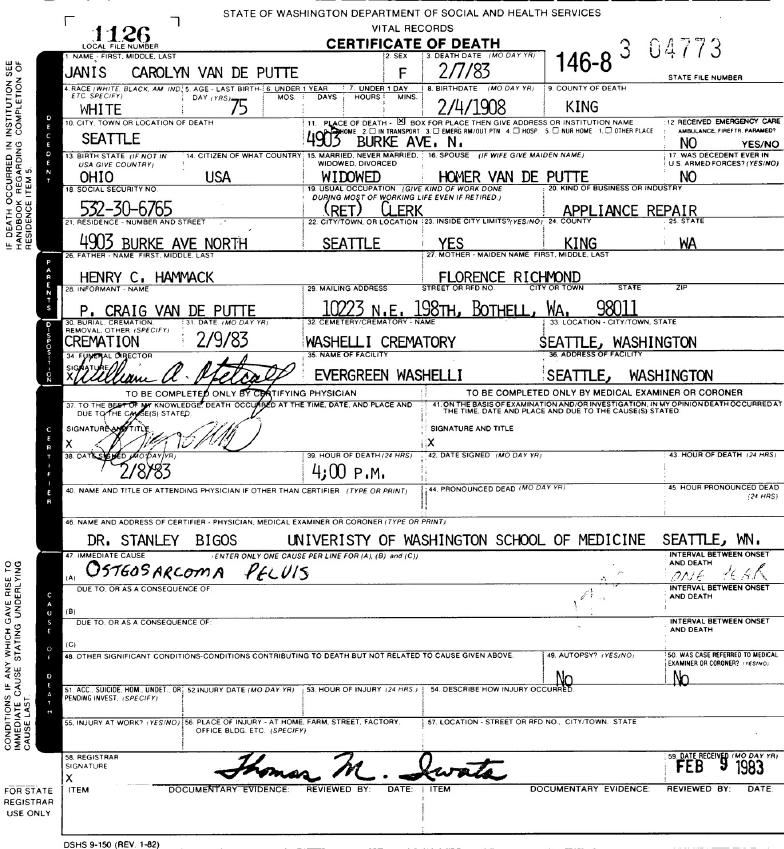
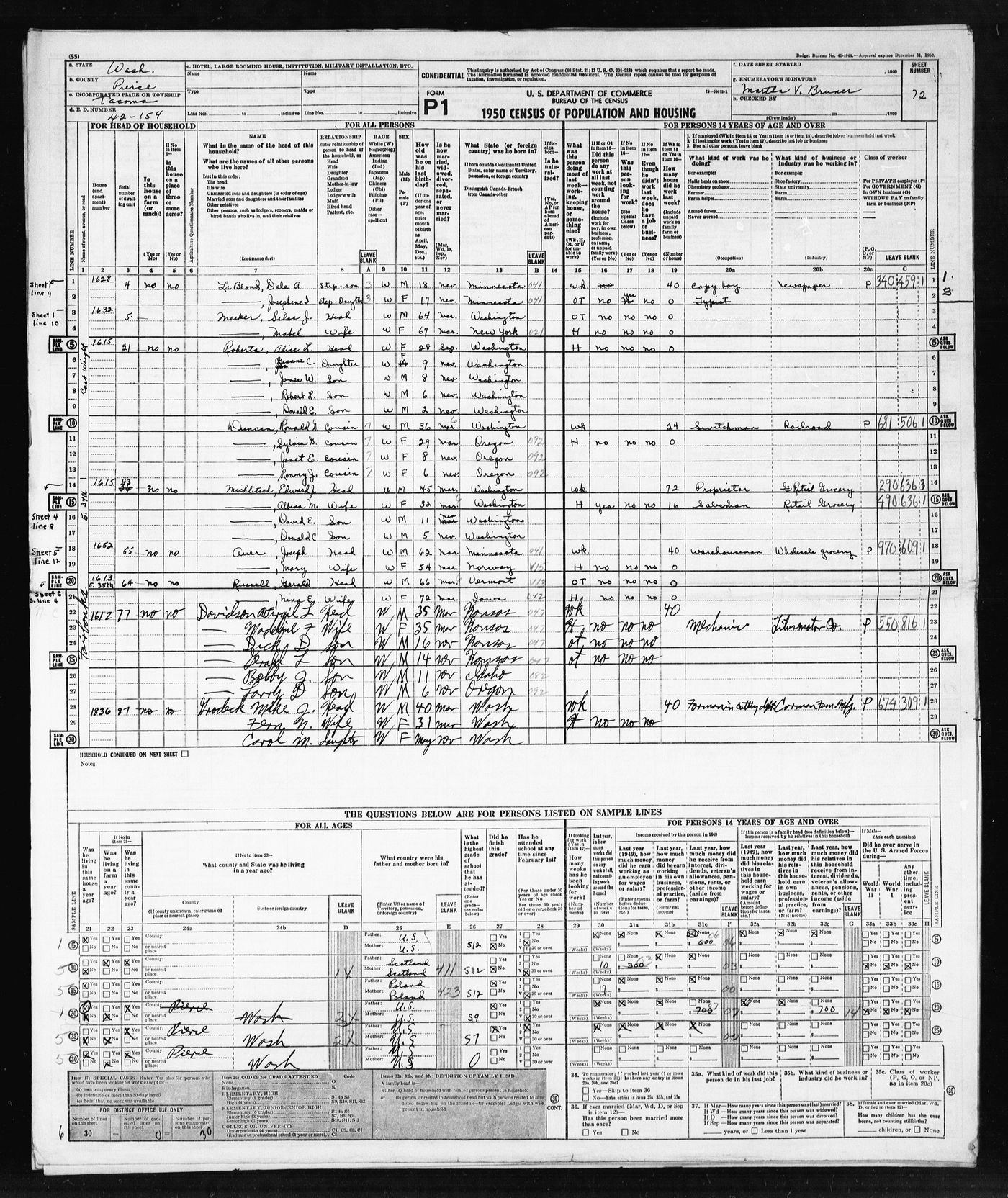
Still to find
The chapters not yet opened- Homer’s twenty years in between He is a five-year-old in a Seattle census in 1910, living in a relative’s house and written down as a nephew. He is a broker in San Francisco when he marries in 1931. Nothing at all covers the twenty-one years between, and nobody now knows why the two surviving boys were not at home. A city directory, or his mother’s 1949 record, would start it.
- Vilas and his parents, on paper The complete 1939 King County marriage packet, and the Archdiocese of Seattle's baptismal register for the twins, Vilas and Vincent. Catholic baptisms name both parents, the mother under her maiden name.
- Where Thomas M. Meeker was buried Moscow, Idaho, in the winter of 1906, ten years after he came down out of the Sierra. Medora was buried there in 1918 and a husband is very likely in the same plot. The sexton's book would say, and so would a Latah County obituary.
- How he got here Zulzeke is answered; the journey is not. No passenger list, no naturalisation paper, nothing yet found that records a boy of sixteen or seventeen leaving Flanders for Puget Sound. Octave's own Zulzeke birth act has since been found and is printed above; what is still missing is the crossing itself. The dates will not sit still either — the certificate's forty years in the United States points at 1890, and the 1889 census has him here already.
- Valley Forge, and whether it holds Somebody has now looked, twice, and the story came back thinner each time. The muster rolls of the encampment carry some twenty-nine thousand names and exactly one Wiseman — a Thomas, of the 1st Maryland, who turns out to be an unlettered South Carolina labourer with two fingers shot away at Long Island, and no relation to anybody here. His older brother Joseph swore out a pension in 1832 and it survives in full: the Berks County militia in 1776, and then North Carolina from October 1777 — two months before the encampment began. He was several hundred miles away that winter, and in a sworn account that a federal investigator went through line by line, he never mentions Valley Forge. Ohio's official roster of Revolutionary soldiers does carry the claim, and credits it to a letter from John's great-granddaughter; its own corrections volume, printed later, quietly drops the sentence. Every road back to Valley Forge ends somewhere short of this family. What the records do show is a family that served: Joseph in the Berks militia, and his father Isaac under a government headstone reading 2nd Class Private, Pennsylvania Militia. So the war is real and the men are real — it is the regiment and the winter that the telling seems to have raised. That is a very ordinary thing for a story to do over a hundred years, and it is not the same as inventing one. His grandson got every other checkable detail right, down to the age on the gravestone. On the other side, Pauline Alexander died somewhere in Allen County between 1880 and 1900, before Ohio kept such records, and her mother came from Vermont; that is all we know of her.
- Two aunts nobody knew about Mrs. Hattie L. Young of Peshastin and Mrs. W. H. Harkness of Molson, Medora's sisters, named in a 1914 obituary. Molson is a near-ghost town on the Canadian line, and Medora herself was living in Medicine Hat that same year. There is a whole northern chapter of this family we have not opened.
- Dad's obituary Not on the web anywhere. It would be in the Stanwood–Camano News archive, or with Gilbertson Funeral Home.